
Data Center Management: What It Is, Why It Matters, and Where It’s Headed
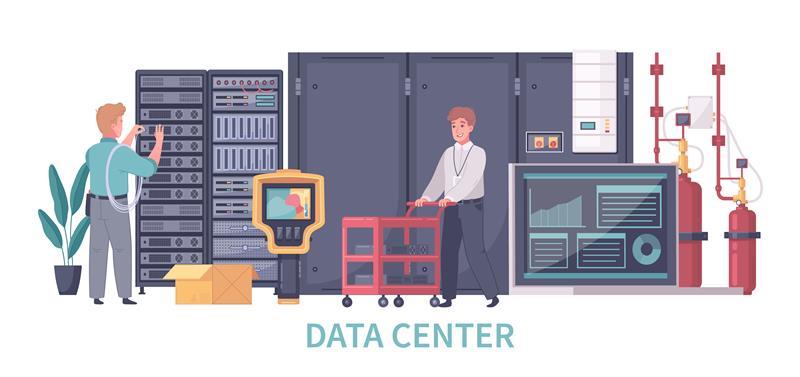
Data center management is the invisible foundation behind every modern digital business. From customer-facing applications and internal systems to analytics platforms and AI workloads, data center management determines how reliably, securely, and efficiently organizations operate in an always-on world.
What was once focused on maintaining physical servers has evolved into orchestrating complex, distributed infrastructure across on-premises environments, cloud platforms, and edge locations. As businesses become increasingly software-driven, data center management has shifted from a technical necessity to a strategic business capability.
What Is Data Center Management?
Data center management is the discipline of operating, governing, and continuously improving the digital infrastructure that runs modern businesses. It includes how computing resources are designed, deployed, monitored, secured, optimized, and evolved over time.
In the past, data center management was largely about keeping physical infrastructure running. Today, it is about orchestrating a complex, distributed, always-on digital system that spans on-prem environments, cloud platforms, and edge locations.
In practical terms, data center management decides how reliable your services are, how fast your teams can move, how secure your data is, and how much you spend to deliver all of it.
Why Data Center Management Has Become Business-Critical
Every core business process today depends on software. Sales, operations, customer experience, finance, supply chains, analytics, and now AI systems all run on infrastructure.
This creates a new reality: infrastructure quality directly determines business quality.
When data center management is weak, organizations experience slow systems, frequent incidents, security exposure, and rising costs. When it is mature, the business gains speed, stability, predictability, and leverage. The difference is not visible in a single server or tool. It is visible in how the entire system behaves under change and stress.
Infrastructure Outcomes vs Business Outcomes
Weak Management Creates | Mature Management Enables |
Reactive firefighting | Predictable operations |
Cost overruns | Controlled, forecastable spend |
Slow releases | Faster time-to-market |
Security gaps | Built-in resilience |
The Real Scope of Modern Data Center Management
Modern data center management is no longer limited to a building or a hardware stack. It now governs a living digital ecosystem.
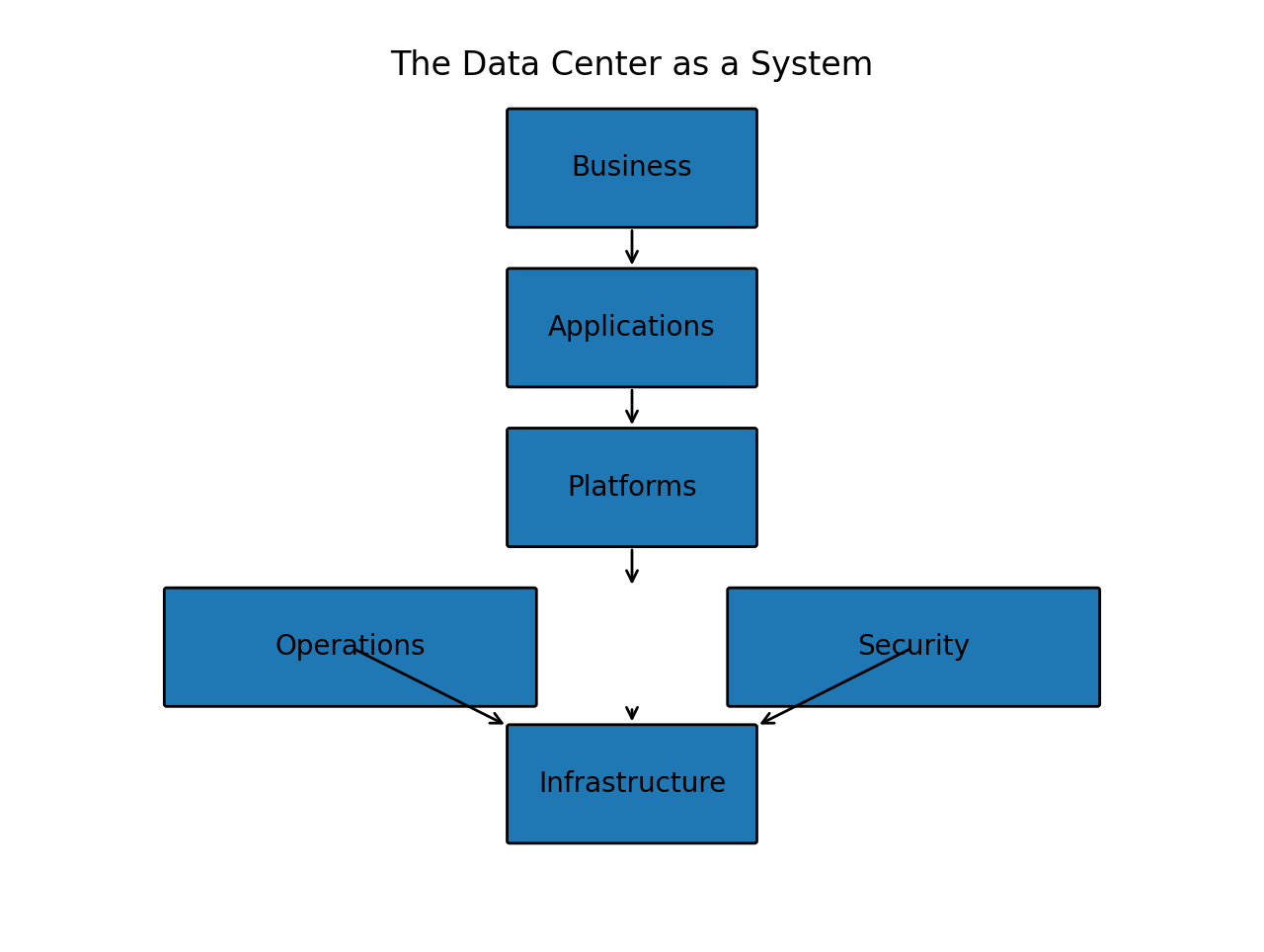
It covers how capacity is planned, how workloads are placed, how failures are absorbed, how changes are rolled out, how security is enforced, and how cost is controlled across a constantly shifting landscape of technologies.
What makes this difficult is not scale alone. It is interdependence. Small changes in one part of the system can create unexpected consequences elsewhere. This is why data center management is increasingly resembling systems engineering rather than traditional IT operations.
The Economic Problem Nobody Talks About
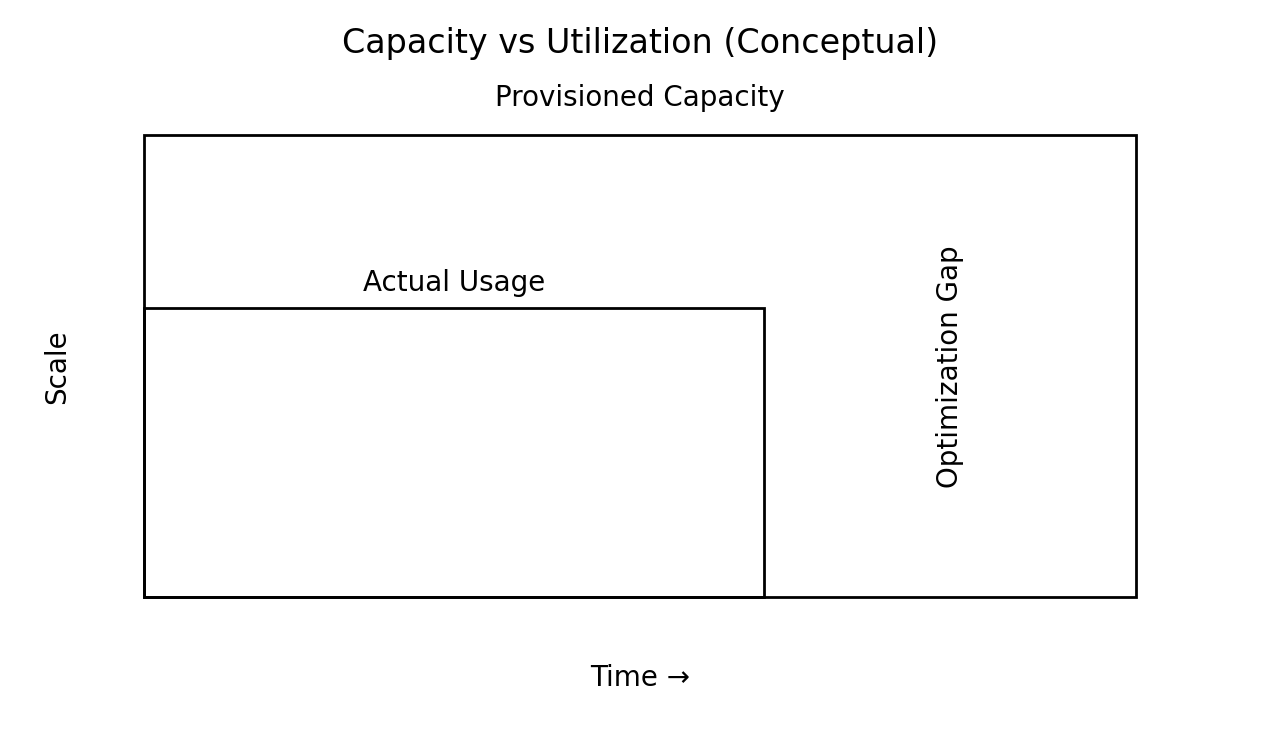
Infrastructure does not behave like most business costs.
Capacity is paid for before it is used. Safety buffers accumulate over time. Systems are rarely decommissioned as aggressively as they are created. The result is that many organizations slowly drift into a state where they are paying for far more than they actually need.Infrastructure does not behave like most business costs.
This is not a waste by negligence. It is a waste of complexity.
Without strong data center management, cost becomes an emergent property of the system rather than a controlled variable. With mature management, cost becomes something that can be intentionally shaped, forecasted, and optimized.
Why Human-Driven Operations Are Reaching Their Limits
Modern infrastructure changes too fast and is too complex to be reliably operated by manual processes alone. Configuration changes, security patches, scaling events, and recovery actions now happen at a pace that exceeds human reaction time.
This is why data center management is shifting from people executing procedures to systems executing policies
Humans still define intent, priorities, and constraints. However, the execution is increasingly happening through automation, orchestration, and intelligent control systems.
This is not about replacing engineers. It is about making the system operable at a modern scale
How AI Is Changing Data Center Management (AIOps Era)
This is where artificial intelligence enters the picture in a serious way. Modern data centers generate enormous volumes of telemetry: logs, metrics, traces, events, performance signals, and configuration data. No human team can realistically analyze this in real time. AI-driven operations (often called AIOps) change the model completely.
Instead of reacting to alerts, AI systems can:
- Detect early signs of abnormal behavior.
- Correlate issues across thousands of components
- Predict failures before they happen.
- Recommend or automatically execute corrective actions.
- Continuously optimize performance, reliability, and cost.
In other words, AI turns data center management from reactive operations into anticipatory systems management.
Over time, this reduces outages, lowers operational load on teams, and makes the entire infrastructure more stable and more economical at the same time.
Resilience Is Now an Architectural Property
In a world where downtime directly impacts revenue and reputation, resilience can no longer be an operational afterthought. Traditional thinking treats failures as exceptional events. Modern data center management treats them as normal and expected. This changes how systems are designed. Instead of building systems that try not to fail, organizations build systems that continue to function when parts of them inevitably do.
The Hybrid and Multi-Environment Reality
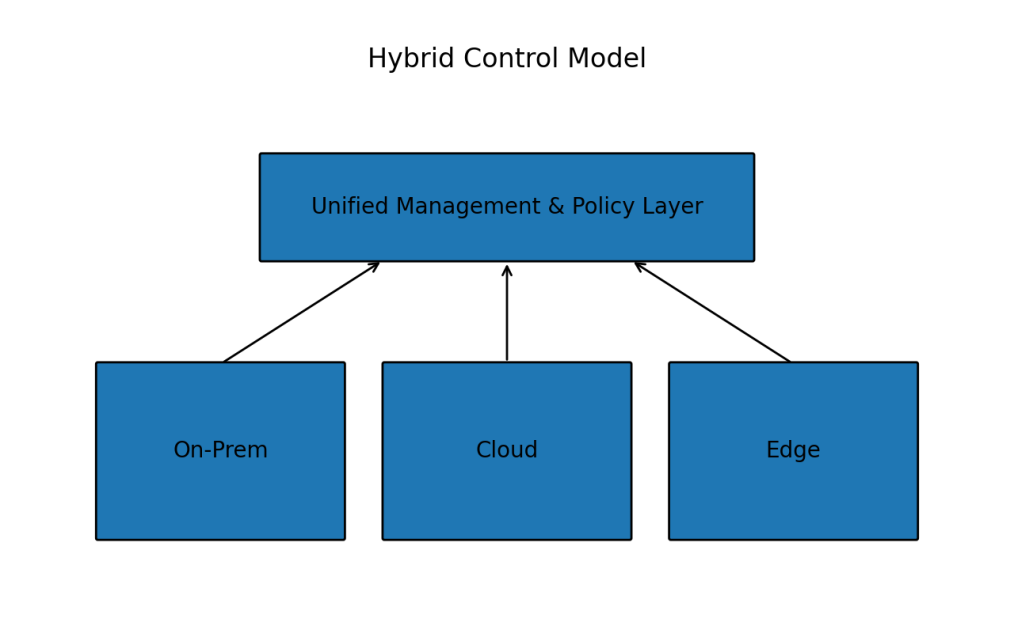
Most enterprises now operate across multiple environments by design. Some workloads live on-premise for regulatory or latency reasons. Others live in public cloud for scalability and speed. Some exist at the edge for real-time processing. This makes data center management less about managing places and more about managing behavior across a distributed system. The real challenge is consistency. Consistent security, consistent governance, consistent visibility, and consistent cost control. This is why modern strategies focus on building a unified control layer rather than optimizing individual environments in isolation.
Where Data Center Management Is Headed
The future of data center management is not more tools or more dashboards. There is more autonomy.
Systems will increasingly:
- Anticipate demand
- Detect abnormal behavior
- Correct inefficiencies
- Heal failures
- Enforce policies automatically
Over time, infrastructure will move from being operated to being directed.
Instead of engineers telling systems how to do things, the business will tell systems what it wants, and the systems will figure out how to make it happen within defined constraints.
This is the transition from operational management to intent-driven infrastructure.
Conclusion: Intelligent Management Is the New Advantage
Data center management is no longer about simply keeping technology running; it is about keeping the business adaptable, resilient, and efficient in a world of constant change. The organizations that succeed will not be those with the largest or most expensive infrastructure, but those with the most intelligent control over it. By combining disciplined systems thinking, automation, AI-driven operations, and unified governance, as exemplified by AS13.AI, data center management evolves from a hidden operational cost into a strategic business asset. In the years ahead, true competitive advantage will belong to businesses that do not just build infrastructure, but manage it intelligently, intentionally, and autonomously.
Blogs


Office Location
5th Floor, 1174, 24th Main Rd 2nd Sector,
Garden Layout, Sector 2, HSR Layout, Bengaluru,
Karnataka 560102
Email Us: info@as13.ai
Follow Us


Roles
AI
Cyber Security
