
MDR vs EDR vs XDR: Which Managed Detection and Response Solution Does Your Business Really Need?
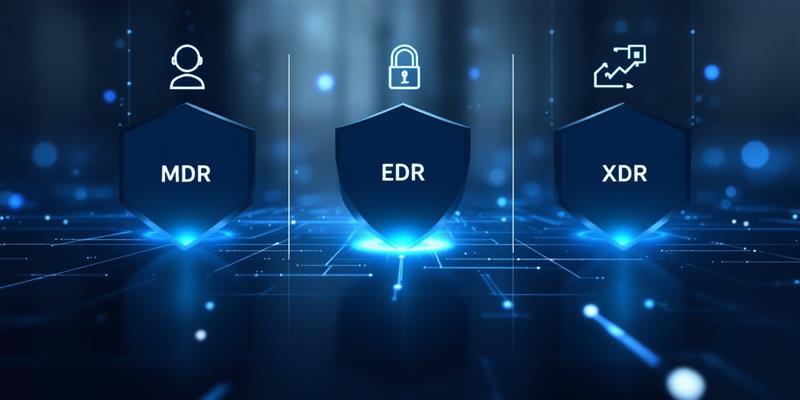
As cyberattacks grow in scale and sophistication, businesses across the US and Europe are reevaluating their cybersecurity strategies. With so many tools and services available, one key question stands out:
Which should we choose: EDR, XDR, or a full Managed Detection and Response (MDR) service?
Selecting the right solution impacts how effectively your business detects, responds to, and recovers from threats. This guide breaks down MDR vs EDR vs XDR, explains the differences, and helps you choose what’s best for your organization.
What Is EDR (Endpoint Detection and Response)?
EDR is a tool focused on securing endpoints—laptops, desktops, servers, and virtual machines. It provides monitoring and alerting, but requires your team to investigate and respond.
How EDR Works
- Installs an agent on each device
- Monitors system activity
- Detects suspicious behaviors
- Sends alerts to your security or IT team
Strengths of EDR
- Strong endpoint visibility
- Good for malware and ransomware detection
- Useful forensic data for investigations
Limitations of EDR
-
Covers endpoints only
-
Requires internal security analysts
-
High volume of alerts (alert fatigue)
What Is XDR (Extended Detection and Response)?
XDR builds on EDR by connecting multiple security layers—endpoint, email, cloud, identity, and network.
How XDR Works
- Collects data from multiple security tools
- Correlates events across systems
- Automatically identifies sophisticated attacks.
Strengths of XDR
- Broader visibility than EDR
- Better accuracy and correlation
- Reduces false positives
Limitations of XDR
- Still requires a security team.
- Needs integration and configuration
- Not a fully managed solution
What Is MDR (Managed Detection and Response)?
MDR is the most comprehensive option. Unlike EDR and XDR (which are tools), MDR is a fully managed cybersecurity service provided by a team of experts who monitor your environment 24/7.
What MDR Includes
- Continuous 24/7 monitoring
- Expert-led threat hunting
- Rapid incident detection
- Immediate threat containment
- Full investigation and remediation guidance
- Compliance-ready reporting
MDR vs EDR vs XDR — Key Differences
Feature | EDR | XDR | MDR |
Coverage | Endpoints only | Multiple layers | Full environment |
Monitoring | No 24/7 | No 24/7 | 24/7 SOC |
Response | Manual | Semi-automated | Fully managed |
Human Expertise | Required | Required | Provided |
Attack Coverage | Limited | Broad | Very high |
Best For | Internal SOC | Growing security teams | SMBs + Enterprises needing full protection |
Which One Does Your Business Actually Need?
Choose EDR If…
- You have an experienced internal SOC.
- You only need endpoint protection.
Choose XDR If…
- You want multi-layered visibility.
- You have analysts for investigations.
Choose MDR If…
- You lack in-house security staff.
- You want 24/7 monitoring.
- You need rapid threat detection and response.
- You want protection across cloud, on-prem, network, email & identity
Why MDR Services Are Growing Fast in the US & Europe
1. Attack sophistication is increasing
Modern attacks often bypass traditional tools, necessitating real-time threat detection and response.
2. Cybersecurity talent shortage
Hiring SOC teams is expensive—MDR bridges the gap.
3. MDR delivers instant expertise
Security experts act as your dedicated team from day one.
4. Compliance requirements are rising
GDPR, ISO 27001, and SOC 2 demand continuous monitoring
5. MDR reduces breach damage dramatically
Fast detection = less downtime, lower cost, and reduced impact.
Final Verdict — MDR Provides the Strongest Protection
- EDR = Strong for endpoints
- XDR = Strong for multi-layered visibility
- MDR = Full-service, human-led, 24/7 cybersecurity
FAQ: Managed Detection and Response (MDR)
EDR focuses on protecting endpoints, while MDR provides full 24/7 monitoring, human-led response, and complete security coverage across your entire environment.
XDR is a tool that correlates signals, but MDR is a fully managed service that includes expert analysts, SOC monitoring, and rapid threat response to stop attacks faster.
Yes. MDR is ideal for SMBs because it eliminates the need for an internal SOC, reduces security costs, and provides enterprise-grade protection
Absolutely. MDR significantly reduces breach impact, improves response time, and lowers overall cybersecurity risk—making it one of the highest-value security services available.
Need Guidance? We're Here to HelpFAQ: Managed Detection and Response (MDR)
Whether you’re comparing MDR, EDR, or XDR, the AS13.AI team is ready to answer your questions and walk you through the best option for your business—without any pressure.Need Guidance? We're Here to HelpFAQ: Managed Detection and Response (MDR)
Office Location
5th Floor, 1174, 24th Main Rd 2nd Sector,
Garden Layout, Sector 2, HSR Layout, Bengaluru,
Karnataka 560102
Email Us: info@as13.ai
Follow Us


Roles
AI
Cyber Security
