
What Is a Managed Security Service Provider (MSSP), and How Does It Work?

Cyber threats are increasing in frequency and sophistication. Most businesses lack the internal resources, expertise, or 24/7 security operations needed to protect themselves effectively.
A Managed Security Service Provider (MSSP) solves this by offering end-to-end protection, monitoring, and incident response all at a predictable cost.
Why MSSPs Matter Today
Businesses today face:
Rising ransomware attacks
Lack of skilled cybersecurity professionals
Increasing compliance pressure
Remote and hybrid workforce vulnerabilities
These challenges make an MSSP a strategic security partner rather than just an outsourced service.
What Is a Managed Security Service Provider (MSSP)?
An MSSP is a cybersecurity company that provides managed security services like 24/7 monitoring, threat detection, incident response, cloud security, and compliance support.
They operate a Security Operations Center (SOC) that continuously monitors your environment and responds to threats in real time.
MSSP vs MSP
- MSP → General IT support
- MSSP → Cybersecurity monitoring & protection
MSSP vs MDR
- MDR = detection and response
- MSSP = full security program + tools + compliance + SOC
How an MSSP Works — Step-by-Step
1. Initial Security Assessment & Onboarding
The MSSP evaluates your environment, identifies risks, and deploys tools like SIEM, EDR, and cloud monitoring.
2. 24/7 Monitoring & Threat Detection
Using advanced detection systems and global threat intelligence, the SOC identifies anomalies immediately.
3. Incident Response & Containment
The MSSP investigates alerts, isolates threats, and recommends or executes remediation.
4. Vulnerability Management & Patching
Continuous scanning identifies system weaknesses and helps prioritize fixes.
5. Compliance & Reporting
Reports support frameworks like ISO 27001, SOC2, HIPAA, GDPR, and more.
6. Continuous Optimization
Security rules, alerts, and policies are constantly updated to improve protection.
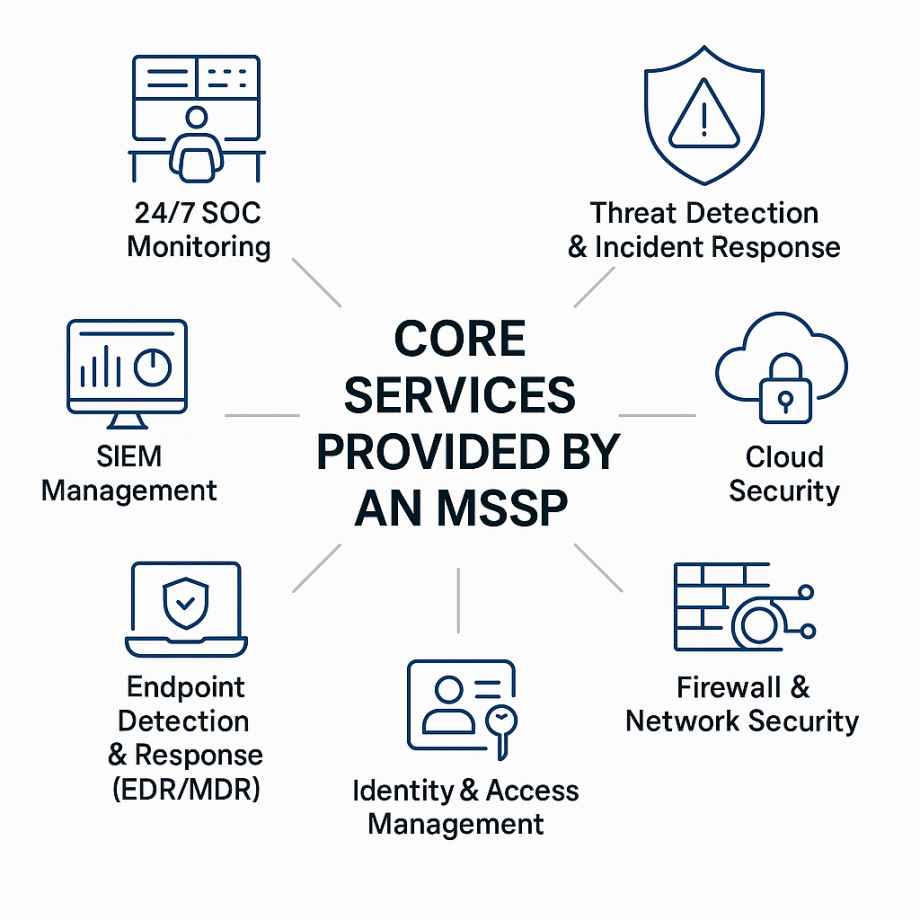
Core Services Provided by an MSSP
Need guidance on achieving SOC 2 Type 2 compliance?
Get Your SOC 2 Type 2 Roadmap Consultation
Key Benefits of Partnering with an MSSP
✔ Cost Savings
Avoid the high cost of staffing and running an internal SOC.
✔ 24/7 Monitoring
Threats don’t wait — and neither do MSSPs.
✔ Expertise on Demand
MSSPs bring certified cybersecurity professionals (CISSP, CEH, OSCP).
✔ Faster Incident Response
Quick containment limits damage and downtime.
✔ Scalability
Easily expand as your business grows.
✔ Enterprise-Grade Tools
SIEM, EDR, and threat intelligence are included at no extra cost.
MSSP vs In-House Security — Which Is Better?
Factor | MSSP | In-House |
Cost | Affordable | Very expensive |
Expertise | High | Hard to hire |
Monitoring | 24/7 | Business hours |
Tools | Included | Costly |
Response | Fast | Slower |
Common Misconceptions About MSSPs
❌ “MSSPs replace IT teams.”
✔ They support them.
❌ “Only large enterprises need MSSPs.”
✔ SMBs are now top attack targets.
❌ “MSSPs are expensive.”
✔ Far cheaper than building an in-house SOC.
How to Choose the Right MSSP
Must-Have MSSP Capabilities
- 24/7 SOC
- Cloud security expertise
- Threat hunting
- Compliance support
- SLAs with guaranteed response times
- Transparent reporting
Questions to Ask
What technologies do you use?
How fast is your average response time?
Can you integrate with our existing tools?
What compliance standards do you support?
Why MSSPs Are Essential Today
A Managed Security Service Provider is more than an outsourced vendor — it’s a strategic partner that enhances your security posture, reduces risk, and protects your business from evolving cyber threats.
With 24/7 monitoring, expert analysts, and advanced tools, an MSSP ensures your business stays safe, compliant, and resilient.
MSSP FAQ: Costs, Benefits, and Use Cases
Monitors, detects, and responds to cyber threats across your IT environment.
Who Should Use an MSSP?
- SMBs with limited IT teams
- Enterprises needing SOC coverage
- Healthcare & finance organizations
- SaaS platforms
- Manufacturing & OT environments
- Hybrid or remote workforce setups
Yes — through proactive monitoring, patching, and incident response.
Yes — through proactive monitoring, patching, and incident response.
No. It enhances your existing team.
Finance, healthcare, retail, SaaS, manufacturing, and any business with security needs.
Talk to Our Security Experts
Ready to strengthen your security posture? Speak with our cybersecurity experts to assess your risks, close gaps, and implement 24/7 protection.
Office Location
5th Floor, 1174, 24th Main Rd 2nd Sector,
Garden Layout, Sector 2, HSR Layout, Bengaluru,
Karnataka 560102
Email Us: info@as13.ai
Follow Us


Roles
AI
Cyber Security
