
Cloud Cost Optimization: The Complete Guide to Reducing Cloud Costs
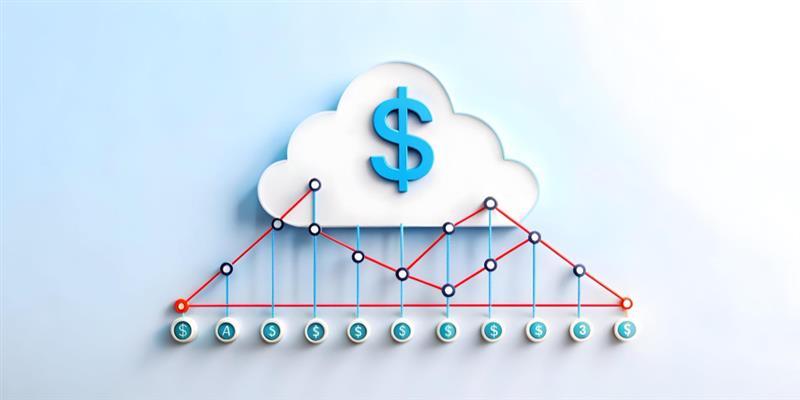
Cloud cost optimization is the process of controlling, reducing, and improving cloud spending while maintaining performance and reliability. As more companies move workloads to AWS, Azure, and Google Cloud, cloud bills often grow faster than expected due to unused resources, over-provisioned servers, and poor visibility. This guide explains what cloud cost optimization is, why cloud costs increase, and how to implement a practical framework to reduce cloud costs by 20–50% without sacrificing performance.
What Is Cloud Cost Optimization?
Cloud cost optimization is a continuous discipline that focuses on spending smarter in the cloud, not just spending less. It ensures that every rupee invested in cloud infrastructure is tied to real business value. Instead of treating optimization as a one-time cleanup, mature organizations embed it into their daily operations and decision-making processes. At a practical level, cloud cost optimization works by removing waste, aligning infrastructure size with actual usage, selecting the right pricing models for each workload, and creating strong visibility and ownership across teams.
Why Cloud Costs Increase So Fast
Cloud costs rarely explode overnight. They grow quietly as teams provision resources quickly and forget to remove or resize them later. Development and test environments, old snapshots, unused disks, and oversized servers continue running in the background and slowly inflate the monthly bill. Another major cause is weak governance and unclear ownership. When multiple teams can create resources without clear accountability, spending becomes fragmented and difficult to control. On top of this, relying only on on-demand pricing for long-running workloads and the steady growth of storage and data transfer charges pushes cloud costs beyond expectations
Benefits of Cloud Cost Optimization
A well-run cloud cost optimization program delivers more than just cost savings. Organizations typically experience:
- 20–50% reduction in cloud spend by eliminating waste and inefficiencies
- Better performance through right-sized and optimized workloads
- More predictable monthly budgets and improved financial planning
- Clearer cost visibility for both engineering and finance teams
- Improved resource utilization across cloud infrastructure
More importantly, cloud cost optimization helps build:
- A culture of efficiency and accountability across teams
- Value-based decision-making instead of guesswork
- Better system architecture designed for both performance and cost
- Healthier long-term cloud usage that scales sustainably
Cloud Cost Optimization Framework: The AS13.AI C.O.S.T.A.R Method
To make cloud cost optimization sustainable and scalable, organizations need more than ad-hoc fixes. They need a structured, repeatable approach. At AS13.AI, we use the C.O.S.T.A.R Framework for Cloud Cost Optimization, a proven methodology that helps companies continuously reduce cloud costs while improving performance, reliability, and scalability. The C.O.S.T.A.R Framework ensures that cloud cost optimization is treated not as a one-time cost-cutting exercise, but as a continuous operational discipline aligned with business growth.
Control: Cost Visibility and Monitoring
Every successful cloud cost optimization initiative starts with visibility. Without accurate and real-time cost data, it is impossible to control, govern, or improve cloud spending. In this stage, organizations implement native cloud cost management tools, enforce consistent resource tagging by project, team, and environment, and establish budgets and alerts. This foundation enables teams to track spending trends, identify abnormal cost spikes, understand which workloads are driving the highest costs, and take action before cloud expenses move out of control.

Optimize: Remove Unused and Idle Resources
Almost every cloud environment contains waste in the form of unused virtual machines, unattached storage volumes, forgotten snapshots, and development environments that were never shut down. These resources continue to generate costs without delivering any business value. By systematically identifying and removing these unused and idle resources, organizations usually achieve 10 to 30 percent immediate cost savings without any impact on production systems

Scale Smart: Right-Sizing Cloud Infrastructure
Over-provisioning is one of the most common and expensive mistakes in cloud environments. Teams often choose larger instance sizes than necessary and never revisit those decisions, which leads to paying for far more CPU and memory than applications actually use. In this stage, real usage patterns are analyzed, and infrastructure is right-sized accordingly. When combined with auto-scaling, this ensures that systems can handle peak demand while remaining cost-efficient during normal operating conditions.

Transform Pricing: Choose the Right Cloud Pricing Models
Many organizations rely too heavily on on-demand pricing because it is simple and flexible. While this works for short-term or unpredictable workloads, it is unnecessarily expensive for stable and long-running systems. By applying Reserved Instances or Savings Plans for predictable workloads and using Spot Instances for non-critical or batch jobs, companies can often reduce compute costs by 30 to 70 percent. A balanced pricing strategy has a significant impact on overall cloud spend.
Archive and Optimize Data: Storage and Data Transfer Optimization
Storage and data transfer costs tend to grow silently over time. Old backups, logs, and rarely accessed data often remain in expensive storage tiers, while cross-region and internet data transfers continue to add to monthly bills. By moving cold data to cheaper storage tiers, removing unnecessary backups, and optimizing data movement, organizations can significantly reduce these hidden and often overlooked costs.
Re-Architect for Efficiency: Architecture Optimization
Long-term and sustainable cloud cost optimization comes from good system design. Well architected systems are not only more scalable and reliable, but also more cost-efficient. This stage focuses on replacing self-managed systems with managed services, adopting serverless architectures where appropriate, introducing caching layers, and improving overall application design. Although this phase requires more engineering effort, it delivers the largest and most sustainable long-term cost savings.
Why the C.O.S.T.A.R Framework Works
The C.O.S.T.A.R Framework ensures that cloud cost optimization is not limited to quick wins, but becomes a continuous, strategic capability. It aligns financial efficiency with technical excellence and helps organizations build a cloud environment that is both cost-optimized and future-ready.
Cloud Cost Optimization Techniques: Comparison
Removing unused resources | Low | High (10–30%) | Quick wins |
Right-sizing instances | Medium | High (15–40%) | Most workloads |
Reserved Instances / Savings Plans | Medium | Very High (30–70%) | Stable systems |
Spot Instances | Medium | Very High (50–90%) | Batch jobs |
Storage tiering | Low | Medium | Data-heavy systems |
Architecture optimization | High | Very High | Long-term scale |
Cloud Cost Optimization: Typical Savings Over Time
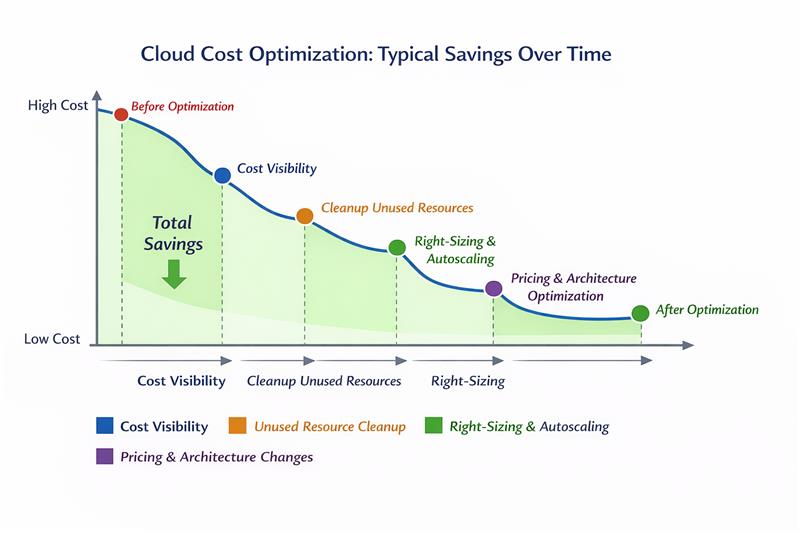
Cloud cost optimization savings over time after visibility, cleanup, right-sizing, and pricing optimization This graph shows a common pattern seen in many organizations. Cloud costs usually drop sharply after cost visibility and cleanup are implemented. They continue to reduce gradually as right-sizing, pricing optimization, and architectural improvements are applied.
What Is FinOps in Cloud Cost Optimization?
FinOps, or Financial Operations, is a practice that brings engineering, finance, and business teams together to manage cloud spending as a shared responsibility. Instead of treating cloud cost as only a financial problem, FinOps makes it part of everyday technical and business decisions. With FinOps, organizations move from reactive cost-cutting to continuous, data-driven optimization aligned with business priorities.
How AS13.AI Helps with Cloud Cost Optimization
At AS13.AI, we help startups and enterprises take control of their cloud spending in a structured and sustainable way. Our approach combines deep technical audits, architectural improvements, and FinOps practices so that cost optimization becomes an ongoing capability rather than a one-time project. Our clients typically achieve a 20 to 40 percent reduction in cloud costs without affecting performance, security, or reliability.
Frequently Asked Questions About Cloud Cost Optimization
Cloud cost optimization is the continuous process of improving cloud spending so organizations only pay for resources they actually need while maintaining performance, security, and reliability.
Most organizations can reduce their cloud bill by 20 to 50 percent, and sometimes more, depending on how much waste and over-provisioning exists.
No. Cloud cost optimization is a continuous process because applications, traffic patterns, and business needs change over time.
Conclusion: Optimize Cloud Costs, Don’t Just Cut Them
Cloud cost optimization is not a one-time task. It is a continuous process that must evolve as your business and cloud environment grow. Organizations that succeed in the cloud are not the ones that spend the most, but the ones that spend the smartest and get maximum value from every rupee invested.
If you want to understand where your cloud money is really going and how much you can save, get a free cloud cost assessment from AS13.AI and start building a more efficient, predictable, and scalable cloud environment.
Blogs


Office Location
5th Floor, 1174, 24th Main Rd 2nd Sector,
Garden Layout, Sector 2, HSR Layout, Bengaluru,
Karnataka 560102
Email Us: info@as13.ai
Follow Us


Roles
AI
Cyber Security
