
What is AI and ML? Meaning, Differences, and Why They Matter Today
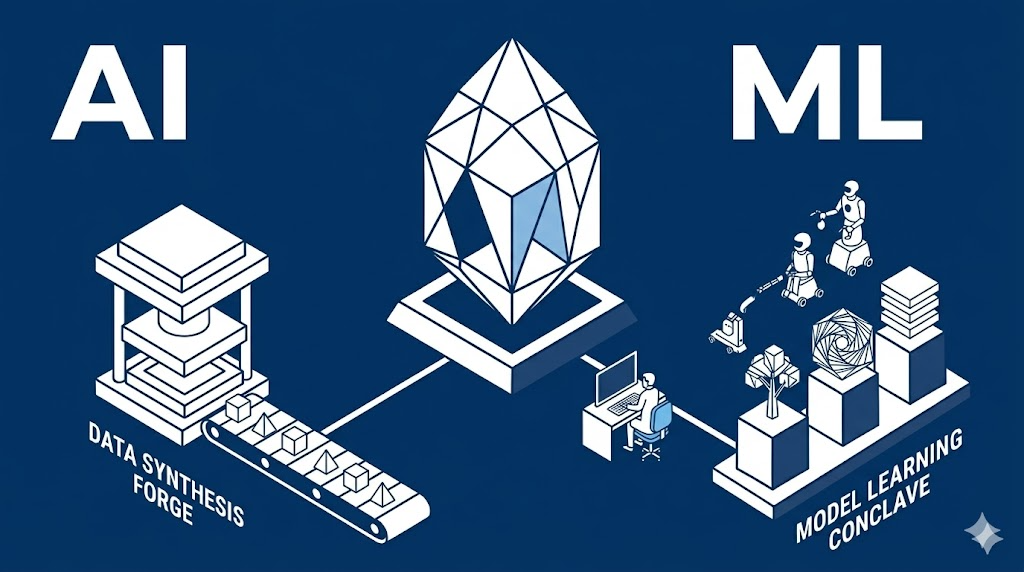
In today’s rapidly evolving digital landscape, artificial intelligence and machine learning have transitioned from theoretical computer science concepts to the foundational pillars of modern enterprise architecture. However, as these technologies dominate headlines, the line between them often blurs. For developers, data scientists, and IT decision-makers, understanding what AI and ML are is no longer optional; it is a critical prerequisite for building scalable, future-proof systems.
This comprehensive guide deeply analyzes the architectures, algorithms, and applications of these transformative technologies. Whether you are looking to integrate predictive analytics into your software or simply want to understand the difference between artificial intelligence and machine learning, this deep dive will provide the technical clarity you need.
Demystifying the Core: What is AI and ML?
To grasp the complexities of modern computing, we must first break down the definitions and the symbiotic relationship between these two fields. When computing professionals ask, "What is AI and ML?", they are essentially asking how we program machines to process information heuristically rather than strictly procedurally.
Defining Artificial Intelligence (AI)
Artificial Intelligence (AI) is the overarching branch of computer science dedicated to creating systems capable of performing tasks that typically require human cognitive function. Unlike traditional software, which operates on hard-coded if-then-else logic, AI systems are designed to perceive their environment, reason through complex variables, and take actions that maximize their chance of successfully achieving a specific goal.
Historically, AI encompassed symbolic logic and expert systems. Today, it encompasses a vast array of AI technologies, including natural language processing (NLP), computer vision, and robotics.
Defining Machine Learning (ML)
Machine Learning (ML) is a specific, mathematically driven subset of artificial intelligence. If AI is the broad goal of simulating intelligence, ML is the primary method we use to achieve it today. Machine learning algorithms parse massive datasets, learn from the underlying mathematical patterns, and make informed decisions or predictions without being explicitly programmed for every edge case.
Therefore, the simplest answer to "what is AI and ML" is that AI is the broader concept of intelligent machines, while ML is the statistical engine that drives that intelligence.
Exploring the Hierarchy: What is AI and ML System Architecture?
To truly analyze the depth of these technologies, we must examine how AI systems are categorized and structured.
The Three Stages of Artificial Intelligence
When examining the scope of AI, researchers divide the technology into three theoretical and practical categories:
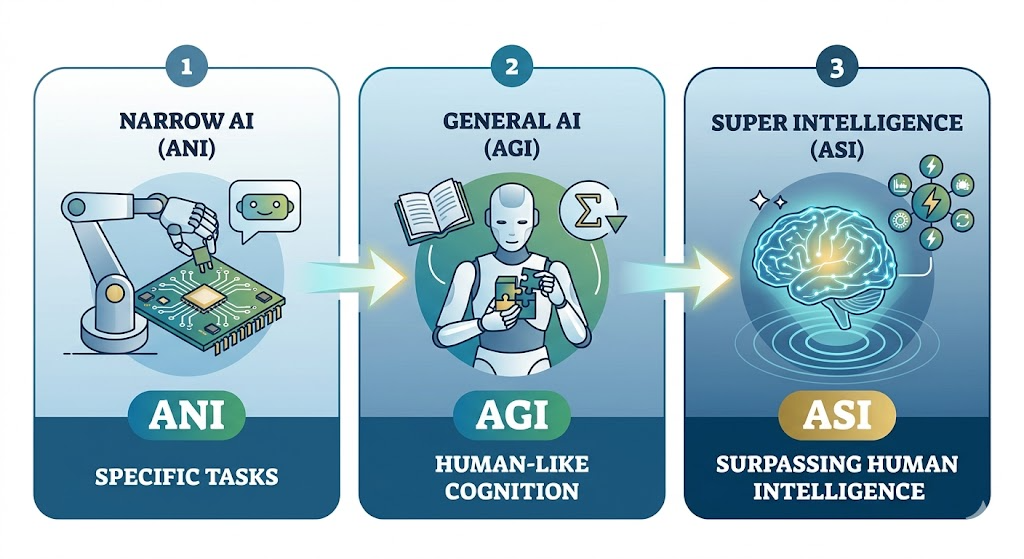
- Artificial Narrow Intelligence (ANI): Also known as "Weak AI," this represents the current state of AI. ANI is highly specialized. A machine learning model trained to detect financial fraud cannot suddenly write a poem or drive a car. It operates strictly within a predefined context.
- Artificial General Intelligence (AGI): Also known as "Strong AI," AGI remains theoretical. This would be a system with generalized human cognitive abilities, capable of transfer learning across completely unrelated domains without human intervention.
- Artificial Super Intelligence (ASI): A theoretical state where machine intellect surpasses the brightest human minds in every field, from scientific creativity to social dynamics.
Key Technologies Powering the AI Ecosystem
Understanding what AI and ML requires looking at the sub-disciplines that make these systems functional in the real world.
- Natural Language Processing (NLP): This allows machines to read, understand, and generate human text. It relies heavily on ML techniques like transformers (e.g., BERT, GPT models) to process sequential data and understand semantic context.
- Computer Vision: This involves training models to derive meaningful information from digital images and videos using Convolutional Neural Networks (CNNs).
- Deep Learning: A highly complex subset of ML based on Artificial Neural Networks (ANNs) with multiple hidden layers. Deep learning is the backbone of modern AI, driving everything from voice assistants to autonomous vehicles.
The Algorithmic Engine: How Does Machine Learning Work?
You cannot fully answer "what is AI and ML" without a deep technical dive into how machine learning models are trained. ML moves away from deterministic programming toward probabilistic modeling.
There are three primary paradigms of machine learning algorithms:
1. Supervised Learning
In supervised learning, the algorithm is trained on a labeled dataset. This means the data includes both the input features (independent variables) and the desired output (dependent variable). The model learns to map the inputs to the correct output by minimizing its error rate over thousands of iterations (epochs).
- Common Algorithms: Linear Regression, Logistic Regression, Support Vector Machines (SVM), Random Forests, and Gradient Boosting algorithms (like XGBoost).
- Best For: Predictive analytics, classification tasks (e.g., spam detection), and regression tasks (e.g., predicting housing prices).
2. Unsupervised Learning
Here, the model is provided with entirely unlabeled data. Its objective is to infer the natural structure, anomalies, or relationships hidden within the dataset without prior guidance on what to look for.
- Common Algorithms: K-Means Clustering, Principal Component Analysis (PCA), and Apriori algorithm.
- Best For: Customer segmentation, anomaly detection (identifying rare network traffic indicating a cyberattack), and dimensionality reduction.
3. Reinforcement Learning
Reinforcement learning (RL) is a behavioral machine learning model. An "agent" learns to behave in an environment by performing actions and observing the results. It is driven by a reward function receiving positive signals for correct actions and negative signals for incorrect ones.
- Common Algorithms: Q-Learning, Deep Q-Networks (DQN).
- Best For: Robotics, real-time strategy gaming, and autonomous navigation.
Key Differences: What is AI and ML When Compared Directly?
To ensure maximum clarity, it is helpful to look at the difference between artificial intelligence and machine learning side-by side.
Core Definition | The simulation of human intelligence by computer systems. | The statistical algorithms that allow computers to learn from data. |
Primary Goal | To create a smart system that can solve complex, generalized problems autonomously. | To maximize accuracy and learn specific patterns from historical data. |
Data Dependency C | Can operate on rules, logic trees, and heuristics (does not always need massive data). | Heavily dependent on large datasets; without data, ML cannot function. |
System Output | Actions, knowledge representation, and dynamic responses. | Statistical predictions, classifications, and data clustering. |
Nature of Operations | Often involves decision-making and cognitive simulation. | Strictly involves mathematical optimization and pattern recognition. |
Data Science and the ML Pipeline
For developers asking "what is AI and ML" from an implementation standpoint, it is crucial to understand that writing the algorithm is only a small fraction of the work. The field of data science dictates a rigorous pipeline:
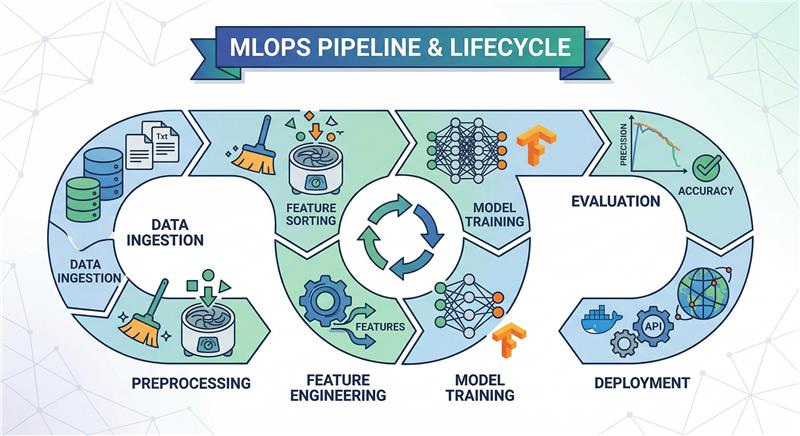
- Data Ingestion and Collection: Aggregating structured data (SQL databases) and unstructured data (text, images, logs).
- Data Preprocessing: Cleaning the data, handling missing values, and normalizing/scaling numerical features. This is often where data scientists spend 70% of their time.
- Feature Engineering: Selecting or transforming variables to improve model performance.
- Model Selection and Training: Choosing the right algorithm (e.g., a neural network vs. a decision tree) and feeding it the training data.
- Evaluation and Tuning: Using a separate validation dataset to test the model's accuracy. Hyperparameters (like learning rate or tree depth) are tuned to prevent overfitting (memorizing the training data but failing on new data).
- Deployment (MLOps): Containerizing the model (using Docker/Kubernetes) and deploying it via APIs to serve real-time predictions in a production environment.
Real-World Impact: Examples of Artificial Intelligence in Daily Life
The theoretical question of "what is AI and ML" becomes much clearer when we examine how these AI technologies are disrupting major industries. 1. Healthcare and Bioinformatics
Machine learning algorithms are revolutionizing diagnostics. Deep learning models can analyze MRI scans and X-rays to detect tumors with a precision rate that often rivals human radiologists. Furthermore, ML is used in drug discovery, simulating how different chemical compounds will interact, thereby reducing R&D time by years.
2. The Financial Sector
Banks rely heavily on AI and ML for quantitative trading and risk management. Unsupervised learning algorithms monitor millions of daily transactions in real-time, isolating anomalous behaviors that indicate credit card fraud. Additionally, NLP is used for algorithmic trading, analyzing global news sentiment to execute high-frequency trades.
3. E-commerce and Personalization
When you shop online or stream media, you are interacting with complex recommendation engines. These systems use collaborative filtering (a type of ML) to analyze your past behavior alongside millions of other users, predicting exactly which product or movie you will want next.
4. Autonomous Systems
Self-driving cars represent the pinnacle of combining AI and ML. They use computer vision (ML) to identify pedestrians and stop signs, while the broader AI system uses reinforcement learning to make split-second decisions on steering and braking
The Future of AI and ML Technologies
As we look toward the horizon, the conversation surrounding "what is AI and ML" is shifting rapidly. The emergence of Generative AI (like Large Language Models) has proven that machines can not only analyze data but also synthesize entirely new content. The future will likely be dominated by:
- Edge AI: Running lightweight machine learning models directly on IoT devices (smartphones, factory sensors) rather than relying on cloud servers, reducing latency and improving privacy.
- Explainable AI (XAI): As deep learning networks become more complex ("black boxes"), there is a massive push in the data science community to develop algorithms that can transparently explain how they arrived at a specific decision, which is critical for compliance in medical and financial sectors.
- Quantum Machine Learning: Leveraging the principles of quantum computing to process multidimensional datasets at speeds impossible for classical binary computers.
Conclusion
Understanding what AI and ML are is the first step toward leveraging their immense power. Artificial intelligence provides the visionary goal of intelligent automation, while machine learning provides the mathematical and data-driven bedrock to make that vision a reality. From predictive analytics driving enterprise strategy to neural networks parsing natural language, these technologies are no longer the future; they are the current operating system of the modern world.
By mastering the difference between artificial intelligence and machine learning, and understanding the rigorous data pipelines required to sustain them, organizations can move past the buzzwords and start building robust, intelligent solutions that drive genuine technological progress.
If you're looking to translate this understanding into real-world impact, explore our AI & ML integration services designed to help you build, deploy, and scale intelligent systems tailored to your business needs.
Blogs


Office Location
5th Floor, 1174, 24th Main Rd 2nd Sector,
Garden Layout, Sector 2, HSR Layout, Bengaluru,
Karnataka 560102
Email Us: info@as13.ai
Follow Us


Roles
AI
Cyber Security
