
SOC as a Service (SOCaaS): A Technical Guide for Enterprise Security Teams
As attack surfaces expand across cloud, hybrid, and SaaS environments, traditional perimeter-based security models are no longer sufficient. Organizations now require continuous security monitoring, real-time threat detection, and rapid incident response across distributed infrastructures. SOC as a Service (SOCaaS) addresses this requirement by delivering enterprise-grade Security Operations Center capabilities as a fully managed service.
SOCaaS enables organizations to operationalize security at scale without the complexity, cost, and staffing challenges of an in-house SOC.
What Is SOC as a Service (SOCaaS)?
SOC as a Service (SOCaaS) is a managed cybersecurity model where a third-party provider delivers 24x7 security operations, including log ingestion, event correlation, threat detection, incident response, and security reporting.
SOCaaS is typically built on SIEM, SOAR, UEBA, and threat intelligence platforms, integrated with cloud-native telemetry and security controls to provide continuous visibility and actionable security outcomes.
The Evolution from Traditional SOC to SOCaaS
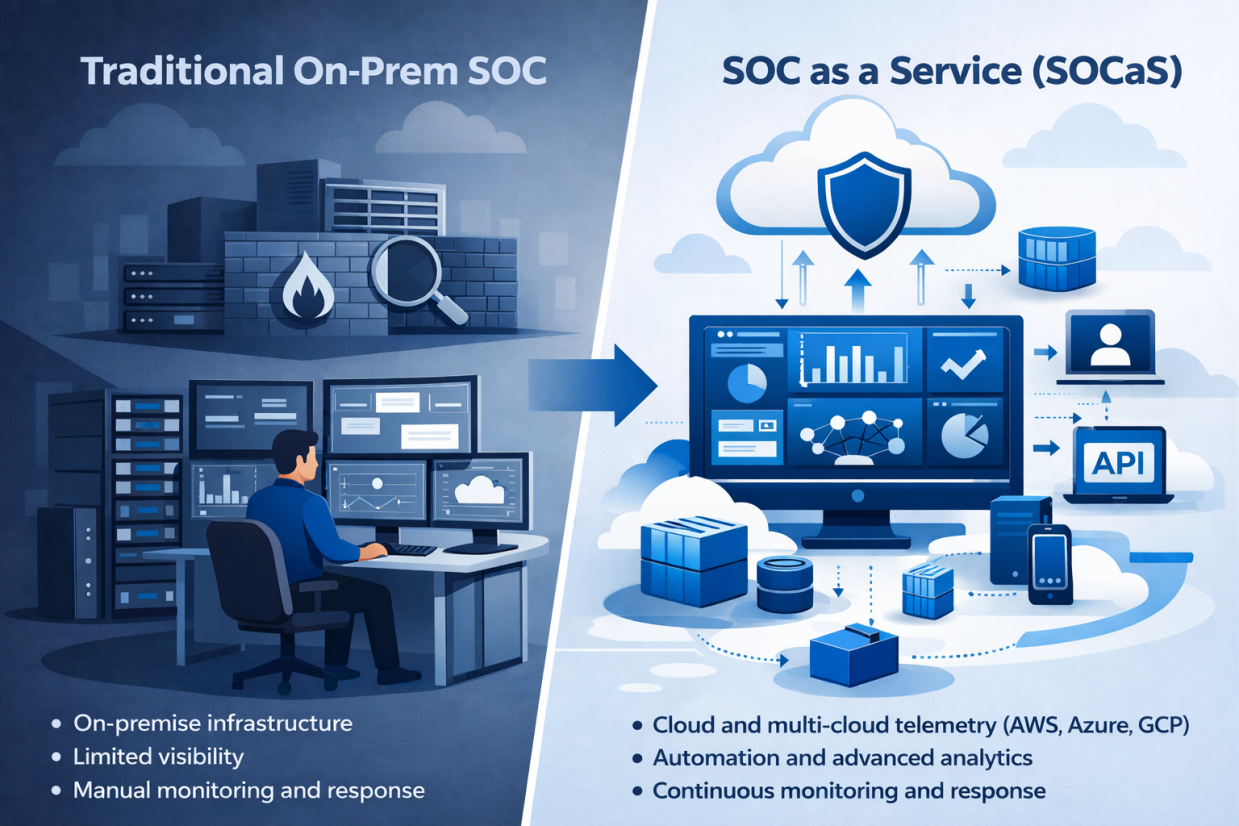
Legacy SOCs were designed for static, on-premise infrastructures. Modern environments introduce new complexities:
-
Cloud and multi-cloud workloads (AWS, Azure, GCP)
-
Containerized and ephemeral resources
-
Remote endpoints and identity-based attacks
-
API-driven applications and SaaS platforms
SOCaaS modernizes security operations by adopting cloud-native architectures, automation, and managed expertise.
Core Technical Components of SOC as a Service
Security Information and Event Management (SIEM)
SOCaaS relies on SIEM platforms to:
-
Collect and normalize logs from cloud, network, endpoint, and application sources.
-
Correlate events across multiple data domains
-
Detect anomalies using rules and behavioral analytics.
Security Orchestration, Automation, and Response (SOAR)
SOAR enables:
-
Automated alert triage and enrichment
-
Playbook-driven incident response
-
Reduced Mean Time to Detect (MTTD) and Mean Time to Respond (MTTR)
User and Entity Behavior Analytics (UEBA)
UEBA enhances SOC detection capabilities by:
-
Establishing behavioral baselines
-
Identifying insider threats and compromised accounts
-
Detecting low-and-slow attack techniques
Threat Intelligence Integration
SOCaaS platforms ingest:
-
Open-source and commercial threat feeds
-
Indicators of Compromise (IOCs)
-
Tactics, Techniques, and Procedures (TTPs) mapped to MITRE ATT&CK
SOCaaS Architecture: How It Works Technically
1. Telemetry Collection
-
Data sources include:
-
Cloud logs (AWS CloudTrail, Azure Activity Logs)
-
Network devices (firewalls, IDS/IPS)
-
Endpoints (EDR/XDR agents)
-
Identity platforms (IAM, SSO, MFA)
-
Applications and APIs
2. Log Processing & Normalization
-
Parsing and schema normalization
-
Timestamp alignment
-
Noise reduction and filtering
-
Data quality optimization
3. Detection Engineering
-
Correlation rules and analytics
-
Behavior-based detections
-
Use case development aligned to risk models.
4. Alert Triage & Investigation
-
Analyst validation of alerts
-
Contextual enrichment
-
False positive elimination
5. Incident Response & Remediation
-
Containment actions
-
Root cause analysis
-
Recovery and hardening guidance
SOC as a Service vs Traditional Managed Security Services (MSSP)
Capability | SOCaaS | Traditional MSSP |
Detection Depth | Advanced analytics & UEBA | Signature-based |
Cloud Coverage | Native cloud visibility | Limited |
Automation | SOAR-driven | Manual |
Custom Use Cases | Yes | Minimal |
Reporting | Compliance & risk-based | Basic |
SOCaaS for Cloud, Hybrid, and Multi-Cloud Environments
SOCaaS is purpose-built for:
- Cloud-native security telemetry
- Dynamic asset discovery
- Container and Kubernetes monitoring
- Zero Trust and identity-driven security models
This ensures continuous security posture monitoring even in rapidly changing environments.
Compliance, Governance, and Risk Management
SOC as a Service supports regulatory and governance requirements such as:
- ISO 27001
- SOC 2 Type II
- PCI-DSS
- HIPAA
- GDPR
By maintaining audit-ready logs, evidence, and security metrics, SOCaaS simplifies compliance management.
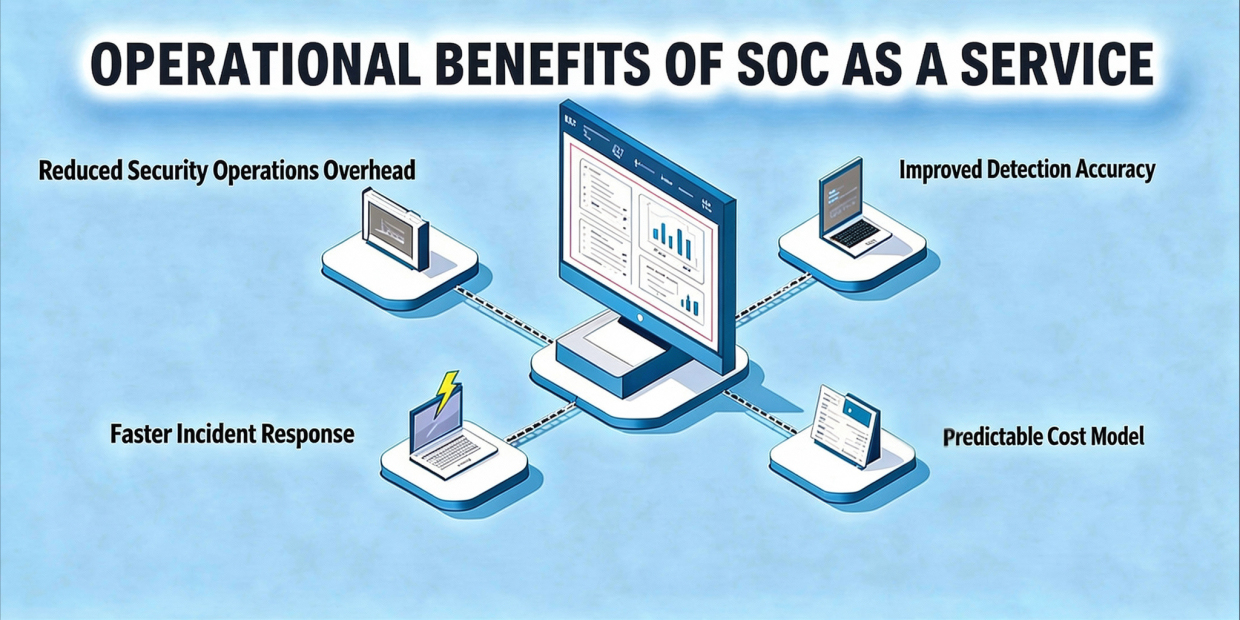
Operational Benefits of SOC as a Service
Who Should Adopt SOC as a Service?
SOCaaS is ideal for:
-
Organizations with limited internal security teams
-
Enterprises migrating to cloud and SaaS platforms
-
Regulated industries requiring continuous monitoring
-
Businesses seeking faster SOC maturity
Detection Engineering & Use Case Development in SOCaaS
Modern SOCaaS providers continuously:
- Develop detection use cases aligned with MITRE ATT&CK.
- Tune correlation rules based on threat intelligence
- Validate detections through Purple Team exercises.
This ensures security operations remain proactive rather than reactive.
SOC as a Service (SOCaaS) is a managed cybersecurity service that provides 24/7 security monitoring, threat detection, incident response, and reporting without the need to build an in-house SOC.
SOCaaS collects logs and telemetry from cloud, on-prem, and SaaS environments, analyzes them using SIEM and analytics, and responds to threats through automation and security analysts.
SOCaaS offers cloud-native visibility, advanced analytics, automation-driven response, and custom detection use cases, while traditional MSSPs focus mainly on basic alert monitoring.
Yes. SOCaaS is designed for cloud, hybrid, and multi-cloud environments, including AWS, Azure, GCP, containers, APIs, and SaaS platforms.
SOC as a Service: The Future of Security Operations
As cyber threats become more complex and environments more dynamic, SOC as a Service is emerging as the preferred security operations model. By combining automation, analytics, and expert oversight, SOCaaS enables organizations to detect, respond, and recover faster—without operational friction.
Blogs


Office Location
5th Floor, 1174, 24th Main Rd 2nd Sector,
Garden Layout, Sector 2, HSR Layout, Bengaluru,
Karnataka 560102
Email Us: info@as13.ai
Follow Us


Roles
AI
Cyber Security
