
What Is Business Intelligence (BI)? A Complete Guide for Data-Driven Businesses

Business Intelligence (BI) is a combination of technologies, processes, and tools used to collect, analyze, and present data in a way that supports better business decisions. A modern business intelligence system brings together data from multiple sources, such as cloud platforms, SaaS tools, databases, and business applications, then cleans and organizes this data to ensure accuracy and consistency. It analyzes information using queries, metrics, and advanced analytics, and presents insights through dashboards, reports, and visualizations that are easy for teams to understand and act on. This helps decision-makers continuously monitor performance, track progress, and identify trends across the business.
A modern business intelligence system typically:
-
Collects data from multiple sources such as cloud platforms, SaaS tools, databases, and business applications
-
Cleans and organizes the data to ensure accuracy and consistency.
-
Analyzes the data using queries, metrics, and advanced analytics
-
Presents insights through dashboards, reports, and visualizations
-
Helps decision-makers monitor performance and identify trends
In simple terms, Business Intelligence answers three key questions:
-
What is happening in the business?
-
Why is it happening?
-
What should we do about it?
Why Business Intelligence Is Important
As organizations grow more digital, they also become more complex. Data is spread across many systems, teams, and platforms. Without Business Intelligence, this data often becomes:
-
Fragmented and inconsistent
-
Difficult to trust
-
Slow to analyze
-
Hard to use for real decision-making
Business Intelligence solves this by creating a single, reliable view of the business.
Some of the key benefits of Business Intelligence include:
-
Faster and more confident decision-making
-
Better visibility into business performance
-
Improved operational efficiency
-
Stronger financial control and cost optimization
-
Better alignment between business and technology teams
How Does Business Intelligence Work?
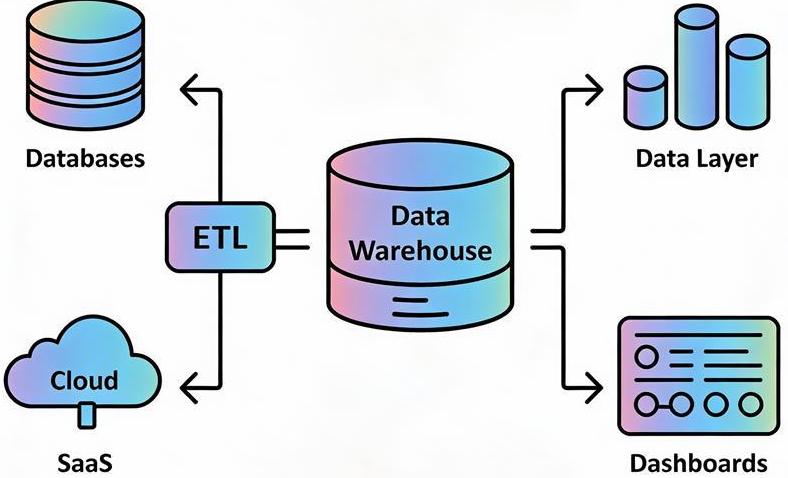
A Business Intelligence platform works by moving data from source systems to decision-ready insights through a structured process.
This process usually includes:
- Data collection from business systems, cloud platforms, and applications
- Data processing using ETL or ELT pipelines to clean and transform data
- Data storage in a data warehouse, data lake, or similar platform
- Data analysis using queries, metrics, and analytical models
- Data visualization through dashboards, reports, and alerts
This approach ensures that everyone in the organization works with consistent, accurate, and up-to-date information.
Business Intelligence Architecture Explained
A modern Business Intelligence architecture is designed to be scalable, secure, and reliable.
It typically includes:
- Data sources such as ERP, CRM, finance systems, cloud platforms, and applications
- Data pipelines for integration and transformation
- A data platform, such as a data warehouse or data lake
- An analytics layer for querying and modeling data
- A visualization layer for dashboards and reports
- Governance and security layers for access control, data quality, and compliance
Together, these components form a complete Business Intelligence platform that can support both operational and strategic decision-making.
What Are Business Intelligence Tools Used For?
Business Intelligence is used across every part of an organization.
For leadership and management, BI helps with:
For leadership and management, Business Intelligence (BI) plays a crucial role in enabling informed decision-making by providing clear visibility into organizational data. It helps leaders track overall company performance and key performance indicators (KPIs), ensuring that goals are being met effectively.

For finance teams, BI supports:
For finance teams, Business Intelligence (BI) supports accurate and strategic financial decision-making by delivering clear insights into financial data. It enables detailed revenue and expense analysis to track cash flow and identify financial trends. BI also assists in budgeting and financial planning by providing forecasts and scenario analysis based on historical and real-time data

For sales and marketing teams, BI enables:
For sales and marketing teams, Business Intelligence (BI) enables data-driven decision-making by offering deep insights into the customer journey and campaign effectiveness. It helps teams analyze sales funnels and conversion rates to identify drop-off points and optimize performance. BI also allows for accurate tracking of campaign performance across channels, measuring ROI and engagement

For operations and IT teams, BI provides:
For operations and IT teams, Business Intelligence (BI) provides critical insights to improve efficiency, reliability, and planning. It enables detailed analysis of process performance to identify bottlenecks and optimize operational workflows. BI also supports resource and capacity planning by helping teams allocate people, systems, and assets more effectively based on data-driven forecasts.

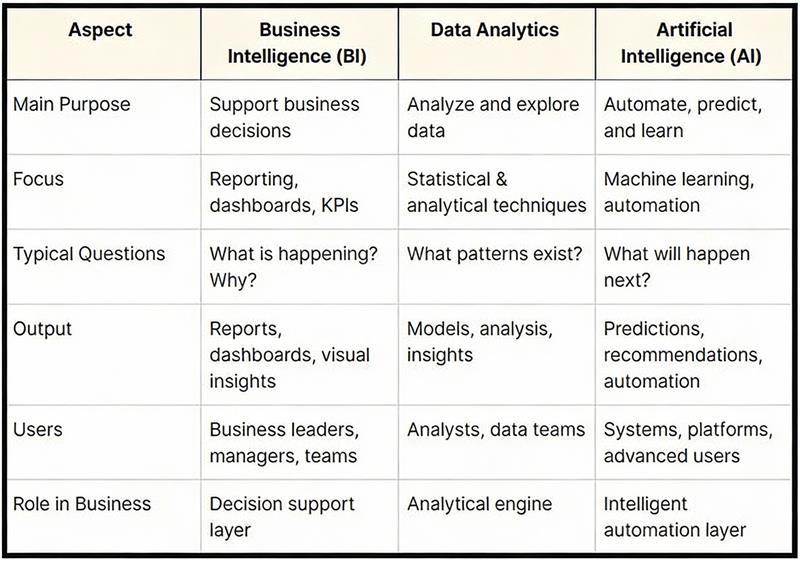
Business Intelligence vs Data Analytics vs Artificial Intelligence
Key Features of Modern Business Intelligence
Modern Business Intelligence platforms offer much more than static reports.
Common features include:
- Interactive dashboards and visualizations
- Self-service analytics for business users
- Real-time or near real-time data updates
- Automated alerts and performance monitoring
- Strong data governance, security, and access control
These features make BI more accessible, reliable, and useful across the organization.
Most organizations today run their business on cloud platforms and digital infrastructure. This creates new challenges related to cost control, performance, reliability, and security.
Business Intelligence helps organizations:
Track cloud usage, spending, and efficiency
- Monitor system performance and availability.
- Analyze security events and compliance status.
- Connect technical metrics to business impact.
This makes BI a critical tool not only for business teams, but also for IT and security teams.
Real-World Business Intelligence Use Cases
Business Intelligence is used in many practical scenarios, such as:
- Executive dashboards for business performance
- Financial reporting and profitability analysis
- Sales and revenue performance tracking
- Cloud cost optimization and usage analysis
- Operations and service delivery reporting
- IT and infrastructure performance monitoring
- Risk, compliance, and audit reporting
How to Build a Successful Business Intelligence Strategy
A successful BI initiative starts with business goals, not tools.
Some best practices include:
- Clearly define the decisions you want to improve.
- Identify the most important metrics and KPIs
- Build a scalable and reliable data architecture.
- Ensure strong data governance and quality processes.
- Focus on user adoption and ease of use.
When BI is designed around real business needs, it becomes a daily decision-making tool rather than just a reporting system.
Frequently Asked Questions (FAQ)
Business Intelligence is the process of using data, reports, and dashboards to understand how a business is performing and to make better decisions.
Popular BI tools include Power BI, Tableau, Looker, and other analytics and dashboard platforms. Many organizations also build custom BI systems on top of their data platforms.
No. Small and mid-sized businesses also use Business Intelligence to track performance, control costs, and support growth.
Data Analytics focuses on how data is analyzed. Business Intelligence focuses on how those results are used to support business decisions. No. Small and mid-sized businesses also use Business Intelligence to track performance, control costs, and support growth.
How AS13.AI Helps You Succeed with Business Intelligence
Understanding Business Intelligence is only the beginning. The real impact comes from building a BI system that fits your business, scales with your data, and delivers insights that teams use. AS13.AI helps organizations design and implement end-to-end Business Intelligence solutions that unify data from cloud platforms, business applications, IT systems, and security tools into a single, trusted analytics layer. We focus on building secure, scalable, and easy-to-use BI platforms that provide clear visibility into performance, cost, risk, and growth. Whether you are starting fresh or modernizing existing reporting, AS13.AI turns analytics into a true business capability—not just a reporting tool.
Blogs


Office Location
5th Floor, 1174, 24th Main Rd 2nd Sector,
Garden Layout, Sector 2, HSR Layout, Bengaluru,
Karnataka 560102
Email Us: info@as13.ai
Follow Us


Roles
AI
Cyber Security
